
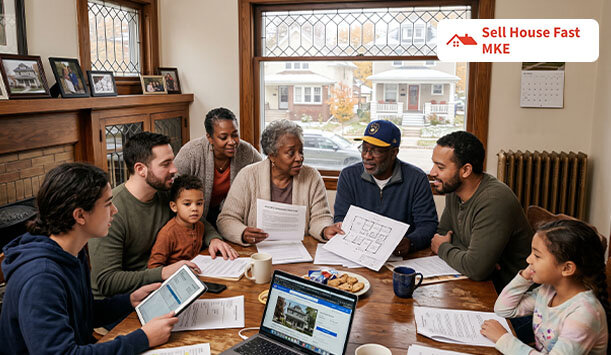
A house can bring a family together. Then one day, the family has to decide what to do with it.
Perhaps a parent passed away, leaving the property to several children. Perhaps siblings bought a house together years ago. Perhaps one family member lives there while the others live elsewhere.
Whatever the reason, sharing ownership can quickly become complicated. One person wants to sell, another wants to keep the house, someone else thinks it needs to be fixed up first, and the person living there may not be ready to leave. Now a house that once belonged to the family has become a decision the family can’t agree on.
Owning The House Together Doesn’t Mean Everyone Wants the Same Thing
When several people own a property, each may have a different idea about what should happen next. One sibling might view it as a valuable asset worth keeping, while another might see it as a house that costs too much to maintain. Sometimes one owner may have emotional ties to the property, while another may simply want their share of the money and move on.
Although there isn’t one right answer, it can be challenging to get everyone to agree. Wisconsin’s State Bar has specifically discussed the difficulties that can arise when multiple family members own property, including disagreements about expenses, use of the property, and future ownership.
The Deed Matters More Than Most Families Realize
Before deciding what to do with a jointly owned house, it’s worth learning how the property is titled because co-ownership isn’t always structured the same way.
For example, Wisconsin recognizes both tenancy in common and joint tenancy. Under a tenancy in common, each owner holds an undivided interest in the property, and there is no automatic right of survivorship. Under joint tenancy, the surviving joint tenant generally becomes the owner upon the death of another joint tenant.
A family might assume that a house is simply divided among the children, yet the actual ownership documents may tell a different story. It is worth checking the deed, and getting proper legal advice is a sensible first step when several people are involved.
Selling an Inherited House Can Add Another Layer
Inheriting houses can be particularly difficult. The property may contain decades of family belongings, and often nobody wants to be the one who decides what to throw away. Disagreements may arise over sentimental items. One sibling might live nearby and handle all the cleaning while the others live in other states.
The family also must decide what to do with the house. If they decide that selling is the sensible option, the property doesn’t necessarily need to be turned into a perfect showpiece first. For a family searching to sell my inherited house fast in Milwaukee, selling the property as-is may be worth discussing, especially when repairs, cleaning, and clearing out the house take time and money.
What If One Person Lives in The House?
Imagine three siblings own a Milwaukee house. One sibling has lived there for years, while the other two live elsewhere. When the siblings start to look at their options, they may consider:
- Who will pay the property taxes?
- Who will handle the needed roof repairs?
- Does the person living there cover everything, or should the other owners contribute?
- What happens if one sibling wants to sell while the person living there wants to stay?
Wisconsin legal guidance notes that co-owners can dispute property expenses and use, and that disagreements can eventually lead to partition proceedings. The longer these questions go unanswered, the harder the conversation can become.
Selling Doesn’t Always Require Everyone to Want the Same Thing
The exact legal options depend on how the property is owned and the circumstances. In Wisconsin, a partition action can resolve certain disputes among co-owners. If the parties can’t reach an agreement, a court may divide the property or order a sale. The Wisconsin State Bar has described partition as a common legal remedy when negotiations between co-owners fail.
That doesn’t mean going to court should be the first step. For most families, discussing the options first is far less stressful. But a lawyer can explain the ownership arrangement and what each owner can or cannot do.
What If One Owner Wants to Sell and Another Doesn’t?
When there is a disagreement about selling the home, reviewing the numbers can be helpful. Families should consider:
- What is the property worth?
- How much is owed?
- What would repairs cost?
- What could the house realistically sell for?
- How much would each owner receive after selling expenses?
Once those figures are on the table, the conversation can become much more practical. It doesn’t guarantee agreement, but at least everyone is working from the same information.
A Traditional Sale Isn’t the Only Option
A family can list the property with an agent and go through the standard selling process. But owners looking to sell without a realtor in Milwaukee can also consider a direct sale.
A home-buying company in Milwaukee may be another option for a property that needs work or for a family that doesn’t want to spend months preparing the house for buyers. The key is to compare options rather than assume one approach will automatically be best.
A traditional sale may produce a higher price, but a direct sale may offer a simpler process. So, the right choice depends on the property and what all the owners want.
Sometimes Selling the House Is the Part That Ends the Argument
A jointly owned house can sit in the middle of a family for a long time because no one wants to make the wrong decision or upset a family member. But keeping the house doesn’t always end the disagreement. Sometimes it just means the same conversation happens again six months later.
Once the family knows the property’s value, the cost to maintain or repair it, and each owner’s preferences, the choices become clearer. If you are confused about a house with multiple owners, Sell House Fast Milwaukee can help. We buy houses in Milwaukee, WI, taking the stress off your shoulders. There are no banks, no waiting for mortgage approval, and no stressful open houses.